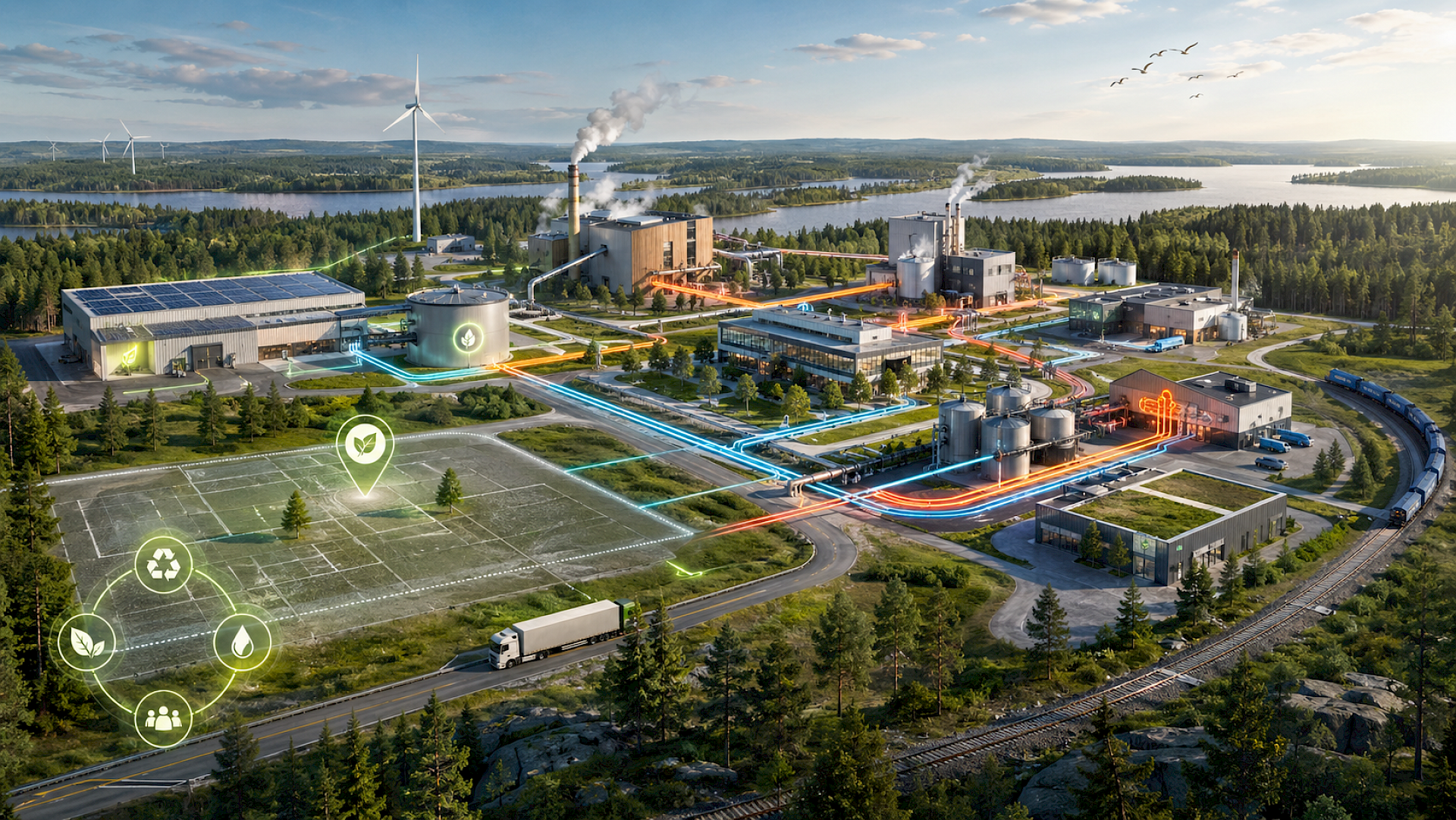
The Kaustinen sub-regional unit has previously carried out several bio- and digital economy studies, the results of which are now to be translated into industrial ecosystems. An industrial ecosystem is an area or entity where several companies work together in a way that benefits each other.
- The project is not making a choice about which industries the industrial parks that may be created in the Kaustinen sub-region are intended for. Instead, it is more a choice about whether we want to be a sub-regional authority seeking future investment at all. It is also possible that we, as a region, will not be involved in future developments. In that case, we will have to accept that we will have to answer to those seeking plots that we are not prepared to participate in their projects," says Tomas Luoma, Project Manager of the Kaustinen sub-region.
How well municipalities and sub-regions succeed in attracting businesses to their area depends to a large extent on the existing capacities. In principle, companies today cannot wait years to start investing, so municipalities need to be proactive and create a framework in advance. In particular, if the planning situation or infrastructure in the area does not allow construction to start within a reasonable period of time, the investment is easily diverted.
- Hardly anyone can say with certainty which industrial operator will be looking for a site in our region in five years' time, for example. What we do know is that if an operator is looking for a location, the first question is whether there is a plan in place to allow the investment," says Luoma, stressing the importance of zoning in creating the necessary capacity.
The KASE Parks project aims to support municipalities in their planning efforts, for example by carrying out studies on what kind of industrial concepts might be possible in the case of the Kaustinen sub-region.
Electricity substations strengthen the sub-region's position as a location for industry
In the Kaustinen sub-region, many things have been done in recent years to promote the emergence of industrial ecosystems.
- We have accumulated a lot of knowledge in several areas, such as biogas, biochar, biothermal plants, energy storage, fertiliser production, processed electricity, data centres and digitalisation. These issues can now be brought together and their synergies assessed. One example of a key variable is waste heat. In rural areas, it is typically not easy to find uses for it, but as part of the bioeconomy, for example, waste heat could be used in different ways. Another clear opportunity in the Kaustinen sub-region relates to electricity transmission.
- Fingrid has two substations under construction in the surrounding area and will add two more in the future, thus improving the availability of energy for industrial operators. With the substations, the Kaustinen sub-region has emerged as an industrial location option alongside many other regions," continues Tomas Luoma.
And what kind of activities could ecosystems be created around in the Kaustinen sub-region?
- There is too much talk about data centres in Finland at the moment, but it remains to be seen how many will be built. It is important to consider other industries, such as food production, the pharmaceutical industry, the defence industry and fertiliser production. Our regional strengths lie particularly in biomass from agriculture and forestry.
Always aiming for a well-considered whole
Alongside project developers and investors, the KASE Parks project's important local target groups are municipalities and landowners in particular, but also businesses and residents. For all of them, the project provides up-to-date information and seeks to maintain interaction between the various parties involved. This will help to avoid situations where a single solution would water down the industrial ecosystem as a whole. The risks are particularly acute in situations where a boom has been launched and land is being reserved in a hurry. According to Luoma, KASE Parks, as a neutral actor, is happy to provide landowners with situational information on land use. Municipalities should also keep in close contact with each other to ensure that the end result is always a well-considered and optimal industrial ecosystem.
The KASE Parks project, which started in early 2026, will run until the end of 2027. In the initial phase, an area or areas will be selected from each municipality in the sub-region to develop a concept based on the strengths of that area and to explore how the actors could benefit from each other.
The next step will be to produce marketing material for the regions, which will be used for the Invest in activities. The current idea is that, at the end of the project, a portal and materials will be made available to project developers and investors to provide them with detailed information on each area, including the current zoning situation, contact details, synergy opportunities, educational cooperation and local businesses.
The Kase Parks project is funded by the Regional Council of Central Ostrobothnia from the European Regional Development Fund (ERDF) and the member municipalities of the Kaustinen sub-region.